That stale smell when the heating or cooling starts, a layer of dust returning soon after cleaning, and staff complaints about stuffy rooms are not just workplace annoyances. They can point to contamination and restricted airflow within the ventilation system. Professional office ventilation cleaning addresses the parts of an HVAC system that ordinary surface cleaning cannot reach, helping create a cleaner, more comfortable environment for staff, visitors and tenants.
For Melbourne offices, schools, retail spaces and shared commercial buildings, ventilation is under constant pressure. Doors open, outdoor dust enters, carpets shed fibres, kitchens create grease and moisture, and air-conditioning systems recirculate air for hours each day. Without planned cleaning, those contaminants can collect in vents, grilles, filters and ductwork.
Why office ventilation cleaning matters
A workplace can look spotless while its air distribution system is carrying built-up dust and debris. Supply vents deliver conditioned air into rooms, while return vents draw air back through the system. Over time, both can collect fine particles, hair, lint, pollen and other airborne material. In damp areas or systems affected by condensation, there may also be conditions that encourage mould growth.
This does not mean every dusty vent is a health emergency. The level of risk depends on the building, the type of contamination, the condition of the HVAC system and the people using the space. However, a dirty ventilation system can contribute to poor air quality, unpleasant odours and reduced airflow. For offices with employees who experience allergies, asthma or respiratory sensitivities, keeping the system clean is a practical part of maintaining a healthier indoor environment.
There is also an operational reason to act. When vents, filters and internal components are obstructed by debris, the system may need to work harder to move air through the building. That can affect comfort across different rooms and place unnecessary strain on heating and cooling equipment. Cleaning is not a replacement for mechanical repairs or regular servicing, but it supports the efficient operation of a well-maintained HVAC system.
Signs your office ventilation needs attention
Some sites need cleaning because they follow a preventive maintenance schedule. Others call after a clear change in comfort or air quality. Common warning signs include visible dust around ceiling vents, black marks near grilles, musty or stale odours when the system runs, inconsistent airflow, and rooms that are noticeably hotter or colder than others.
A sudden increase in dust on desks and workstations is another useful clue, particularly if the office has recently completed renovations, moved furniture, had ceiling works or experienced nearby construction. Building work can introduce large amounts of fine dust into return-air pathways and ducting.
Property managers should also pay attention to tenant feedback. Repeated complaints about stuffiness, lingering odours or dust are worth investigating rather than treating as a purely cosmetic issue. A professional inspection helps identify whether the cause is dirty vents, clogged filters, duct contamination, an exhausted fan, poor system balance or a separate mechanical fault.
What professional cleaning should cover
Effective office ventilation cleaning is more than wiping visible vent covers. A proper scope of work should be based on the system and the building’s needs. In a typical commercial office, that may include accessible supply and return vents, grilles, diffusers, filters, ductwork and relevant air-handling components.
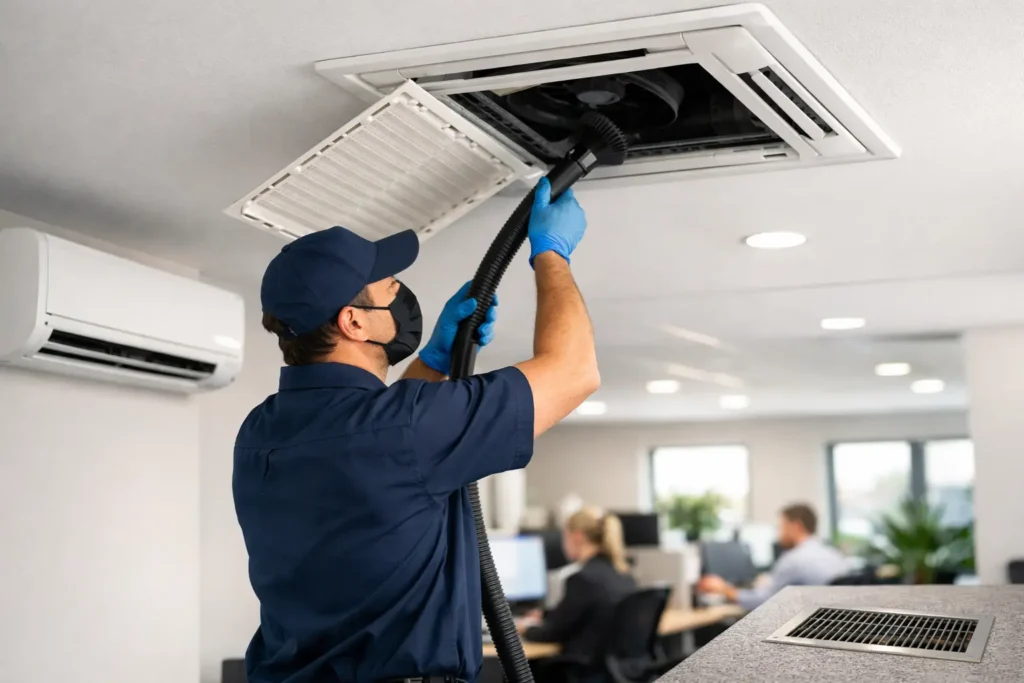
The process normally starts with an assessment of the system, its access points and the visible condition of vents and ducts. Technicians should protect surrounding work areas and use equipment designed to capture loosened debris, rather than simply pushing it further through the building. HEPA filtration is particularly valuable because it helps contain fine dust and allergens during cleaning.
Technicians then use suitable agitation tools and controlled vacuum equipment to remove accumulated material from accessible duct sections and components. Vent covers and grilles can be cleaned separately before being refitted. If filters are dirty, they may require replacement or cleaning according to the manufacturer’s requirements and the type of system installed.
The exact process depends on the layout. A small office with split systems requires a different approach from a multi-storey tenancy with ducted heating and cooling. Likewise, a commercial kitchen exhaust system has different hygiene and fire-safety concerns from standard office supply ducts. The right contractor will explain what is included, what is accessible and whether any mechanical issues need the attention of an HVAC technician.
The workplace benefits go beyond cleaner-looking vents
The most immediate result of professional cleaning is often visible: cleaner grilles, less dust around air outlets and a fresher feel when the system starts. The more meaningful benefit is reducing the debris that has collected within the air distribution pathway.
Cleaner ventilation can support better airflow and more even comfort through the office. When staff are not constantly adjusting jackets, desk fans or thermostats because one zone feels stale, the work environment is simply easier to use. This is especially relevant in meeting rooms, enclosed offices and high-occupancy spaces where air can feel heavy quickly.
For facilities teams and building managers, planned cleaning can also help protect the presentation of the premises. Dusty vents and stained ceiling diffusers are highly visible to clients and tenants. Keeping them clean supports a well-managed workplace and complements routine cleaning, filter changes and HVAC servicing.
There is a sensible financial angle too. A clean system is not guaranteed to solve every energy or performance issue, but removing avoidable build-up helps equipment operate without unnecessary restrictions. If the system remains noisy, weak or uneven after cleaning, that is useful information: the problem may be related to controls, fan performance, duct damage or system design rather than cleanliness alone.
How often should an office ventilation system be cleaned?
There is no single interval that suits every workplace. A lightly used professional office may only require periodic inspection and cleaning as needed, while busy sites can need more frequent attention. Offices near major roads, construction zones or industrial activity may accumulate outdoor dust faster. Buildings with pets, high visitor numbers, older ductwork or persistent moisture issues may also need closer monitoring.
As a practical guide, ventilation cleaning should be considered after renovations, following water damage, when visible dust or odours appear, or when air quality concerns are raised. It is also worthwhile to include duct and vent inspections within a broader maintenance program, alongside routine filter changes and servicing.
Do not wait for a system to look severely neglected. Early action is usually simpler, less disruptive and more effective than allowing dust and debris to build up for years. For offices operating across long hours, cleaning can often be arranged around business activity to minimise interruption to staff and customers.
Choosing a commercial ventilation cleaning contractor
Commercial cleaning work should be carried out by a provider with appropriate equipment, insurance and experience working in occupied properties. Transparent quoting matters because duct systems vary significantly in size, accessibility and condition. A quote should reflect the actual work required, not rely on vague promises or a one-size-fits-all price.
Ask how the contractor contains dust during the job, whether HEPA-filtered equipment is used, what areas are included, and whether they can identify issues outside the cleaning scope. Clear communication is particularly important for property managers coordinating access, after-hours work and tenant expectations.
Top Air Duct Cleaning provides professional commercial duct, vent, exhaust fan and split-system cleaning across Melbourne and surrounding suburbs. Our fully insured technicians use professional cleaning methods and advanced HEPA filtration equipment to remove built-up dust and debris with care for your workplace.
A clean office ventilation system will not replace good building management, but it is a practical step towards fresher air, better comfort and a workplace people feel confident using. To arrange a free quote or discuss same-day availability, call Top Air Duct Cleaning on 0457 666 469 or visit www.topairductcleaning.com.au. A well-maintained system helps your workplace breathe easier, one clean vent at a time.
