
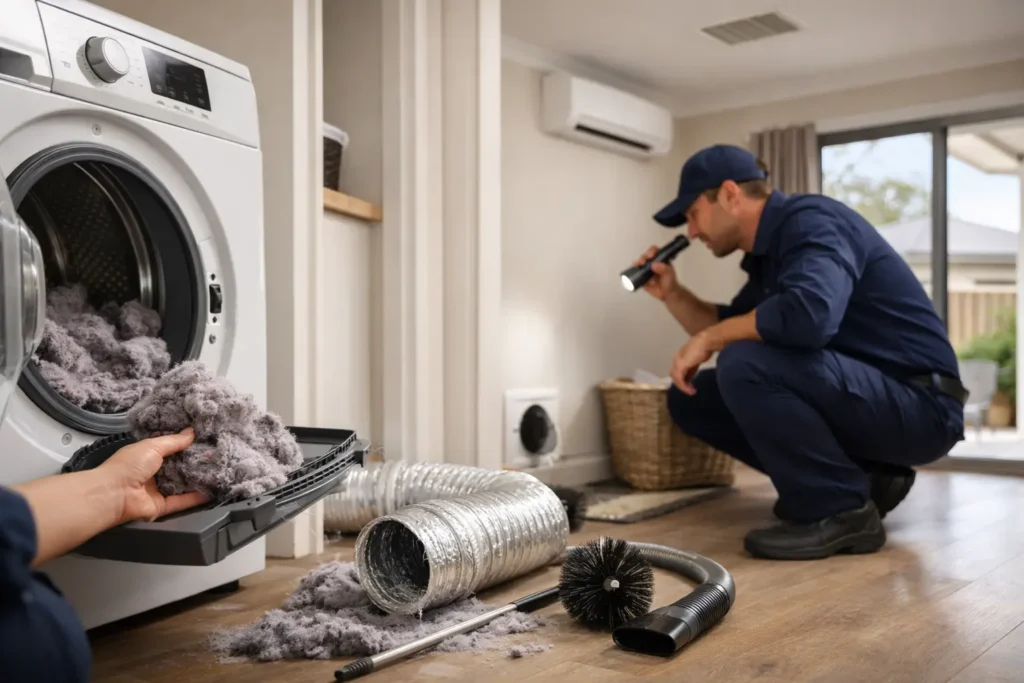
A clothes dryer can look clean and work normally while a serious lint problem is building behind it. The top dryer fire prevention steps focus on one simple issue: keeping heat, lint and restricted airflow from occurring together. For Melbourne households, landlords and facility managers, a few practical checks can significantly reduce risk while helping the dryer run faster and more efficiently.
Why dryers become a fire risk
Every drying cycle pulls fibres from clothing, towels and bedding. The lint filter catches a good portion, but not all of it. Fine lint can pass into the internal duct, settle around the outlet connection, collect behind the appliance or build up at the external vent.
When airflow becomes restricted, the dryer must work harder to remove moisture. Heat rises inside the machine and exhaust line, drying out accumulated lint and increasing the chance of ignition. A dryer may also overheat due to a faulty thermostat, damaged wiring or an unsuitable exhaust arrangement. This is why fire prevention is not only about emptying the filter. It is about maintaining the complete path from the drum to the outdoor exhaust point.
A longer drying time is often the first warning sign. If clothes need two or three cycles, the laundry feels unusually hot, or there is a burning smell, stop using the appliance until the cause has been checked.
Top dryer fire prevention steps to follow
Clean the lint filter after every load
Remove lint from the filter every time the dryer is used. Do not wait until the filter looks full. Even a thin, almost invisible coating can reduce airflow and force the appliance to operate at a higher temperature.
Wash the filter occasionally in warm water with a soft brush, then let it dry completely before replacing it. Fabric softener sheets and laundry products can leave a film that blocks the fine mesh even when it appears clean. Check the filter housing too, as lint often drops below the screen during removal.
Never run a dryer without its lint filter fitted. The filter is a key safety component, not an optional accessory.
Keep the area around the dryer clear
Lint is highly flammable, and it does not only sit inside the appliance. Pull the dryer forward periodically and vacuum the floor, rear panel and surrounding wall area. Pay particular attention to the electrical lead, power point and the gap behind stacked laundry appliances.
Avoid storing cardboard boxes, cleaning products, clothes baskets, paper or spare linen directly beside the dryer. A tidy laundry provides better access for inspections and removes fuel sources should a fault occur.
For strata properties and rentals, this is a useful item to include in routine maintenance checks. It takes little time, but it can reveal loose connections, damaged ducts and heavy dust build-up before they become more difficult problems.
Inspect the exhaust duct, not just the dryer
The duct carrying moist air outside is where many preventable issues develop. Check that it is securely connected at both ends, has no crushing or sharp kinks, and follows the shortest practical route to the outside. Long, winding duct runs slow airflow and allow lint to settle in bends.
Flexible plastic or thin foil-style ducts are poor choices because they can sag, tear and trap lint. A properly installed rigid or semi-rigid metal duct is generally safer and easier to clean. The right configuration depends on the dryer model, available space and manufacturer requirements, so do not modify the exhaust system blindly.
If the duct disappears into a wall, ceiling cavity or roof space, it deserves professional attention. Hidden lint cannot be assessed properly from the laundry alone, and an external vent that looks clear does not prove the full duct is clear.
Check that the outdoor vent opens freely
When the dryer is running, go outside and confirm that warm, moist air is exhausting freely. A weak flow can point to lint accumulation, a crushed duct or a blocked vent hood. The flap or louvre should open during operation and close afterwards without sticking.
Clear leaves, cobwebs and dirt from around the outlet. Do not cover the vent with mesh that is too fine, as it can clog quickly with lint. If birds or pests are a concern, use a purpose-designed external cover that maintains adequate airflow and can be cleaned easily.
A dryer should vent outdoors, not into a roof cavity, garage, underfloor area or enclosed room. Venting indoors adds moisture to the property and can contribute to mould, condensation and poor air quality, while also depositing lint where it should not be.
Use the appliance safely during each cycle
Only use a dryer when someone is at home and awake enough to respond if there is a problem. Avoid running it overnight or when leaving the property. This matters particularly in busy households where laundry is often left to finish after everyone has gone out.
Do not overload the drum. Overloading reduces air movement through the clothes and places extra strain on the motor and heating system. Clean items that have been exposed to cooking oil, solvents, petrol, paint, wax or other flammable substances should not go into a hot dryer unless the manufacturer’s instructions clearly allow it and they have been thoroughly washed.
Use the correct program for the load and allow the cool-down cycle to finish. Taking very hot clothing straight from the dryer and placing it in a crowded basket can retain heat, especially with towels and heavy fabrics.
Take electrical and gas faults seriously
A tripping circuit breaker, flickering power, unusual noise, burning odour or a dryer that feels excessively hot are not normal signs of ageing. Switch the appliance off, unplug it where safe to do so, and arrange assessment by a qualified appliance technician or electrician.
For gas dryers, any smell of gas, soot, poor combustion or unusual flame behaviour requires immediate professional attention. Do not attempt to repair gas connections yourself. The same caution applies to internal dryer components, which can hold electrical charge even after the appliance has been unplugged.
When professional cleaning is the sensible option
A filter cleaned after every load is essential, but it cannot remove lint already lodged in the exhaust path or behind the appliance. Professional cleaning and inspection are particularly worthwhile when drying times have increased, the vent run is concealed, the property has a high laundry volume, or the dryer has not been serviced for a long time.
Commercial settings need closer attention. Laundries in accommodation facilities, salons, gyms, childcare centres and healthcare environments can produce significant lint every day. A documented maintenance schedule helps protect staff, residents and visitors while reducing downtime caused by poorly performing equipment.
At Top Air Duct Cleaning, our experienced Melbourne technicians use professional cleaning methods and HEPA filtration equipment to remove dust and debris from ventilation systems. We can provide practical advice on visible exhaust and airflow concerns as part of a broader indoor air quality and ventilation maintenance plan.
A simple maintenance rhythm that works
Daily care should be limited to cleaning the filter and checking that the appliance is operating normally. Every few months, clean around and behind the dryer, inspect the accessible duct connection and confirm the outdoor outlet is opening properly. At least annually, consider a more thorough inspection of the complete exhaust route, especially if the dryer is heavily used.
The schedule may need to be more frequent for large families, pet owners, shared accommodation and commercial sites. Pet hair, heavy towel loads and frequent use all increase lint production. There is no single interval that suits every property, but any change in drying performance should move maintenance higher on the priority list.
If your dryer is taking too long, producing excess heat or venting poorly, do not treat it as a minor inconvenience. Call Top Air Duct Cleaning on 0457 666 469 or visit www.topairductcleaning.com.au for a free quote and dependable service across Melbourne. Clean airflow is one of the simplest ways to make your laundry safer, cleaner and easier to run.
