
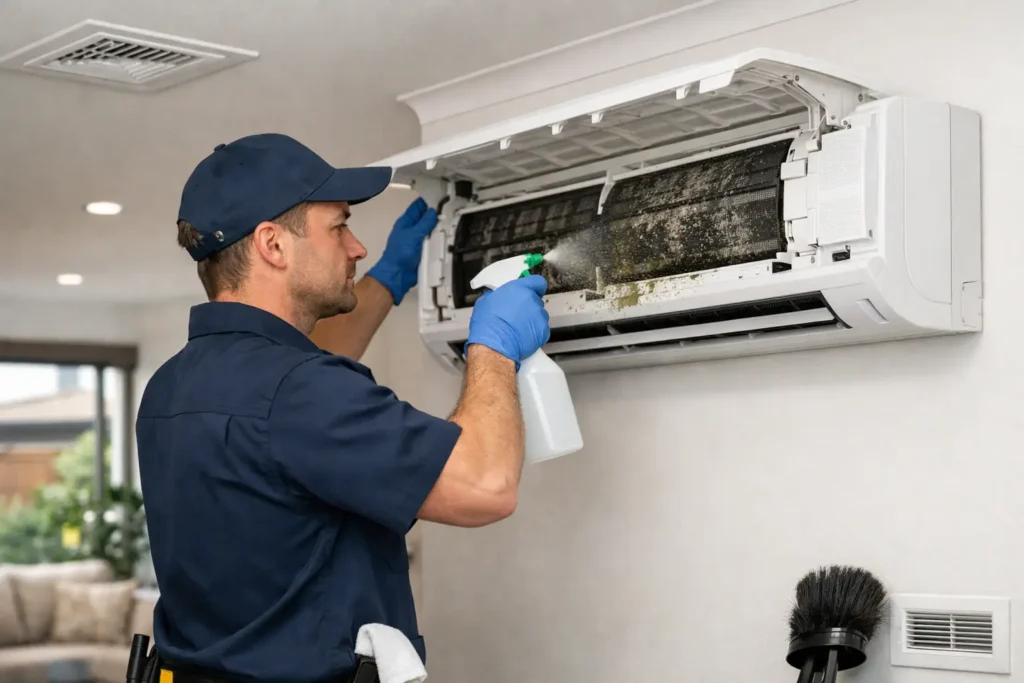
A musty smell when the air conditioner starts is not something to mask with a spray or ignore until summer. It can be a warning that moisture, dust and organic debris have created the right conditions for mould inside the unit. Removing mould from air conditioners properly protects the air moving through your home or workplace, helps restore airflow and reduces the chance of the problem returning.
For Melbourne households and property managers, this often becomes noticeable after a damp winter, long periods without running the cooling system, or when a split system has been working hard through humid weather. The visible mark on a vent or louvre may be only part of the issue. Mould can also sit on filters, evaporator coils, drain trays and internal fan components that cannot be safely reached with a quick wipe.
Why mould develops inside an air conditioner
Air conditioners remove moisture from the air as they cool it. That moisture should drain away through the condensate system. When the drain line is partially blocked, the drain tray is dirty, filters are overdue for cleaning or the unit has poor airflow, moisture can linger inside the system.
Dust adds another part of the problem. It collects on filters and internal components, providing a surface where mould spores can settle. Once a unit is switched on, contaminated air and odours may be circulated into the room. In ducted systems, dust and microbial growth can also be spread through supply vents if the system is not maintained correctly.
Mould does not automatically mean your air conditioner is beyond repair. In many cases, professional cleaning can return it to a cleaner, fresher and more efficient condition. The right approach depends on where the growth is located and whether the underlying moisture issue has been fixed.
Signs your air conditioner needs attention
A dirty filter is common, but mould concerns usually come with more persistent signs. You may notice an earthy or stale odour at start-up, dark spotting on louvres or around vents, reduced airflow, water dripping from an indoor unit, or more dust blowing into the room than usual.
Some occupants may also find that irritation, coughing or allergy symptoms are more noticeable when the system is running. These symptoms can have several causes, so they should not be treated as proof of mould on their own. However, when odour, visible growth and poor performance occur together, arranging an inspection is sensible.
Commercial sites should act quickly. Schools, offices, rental properties, medical settings and customer-facing businesses have a duty to maintain clean, comfortable indoor spaces. A musty-smelling HVAC system can affect occupant confidence as well as day-to-day comfort.
What you can safely clean yourself
Light surface dust on accessible filters and external louvres can often be handled by the property owner. Switch the air conditioner off at the isolator first, then remove the filters according to the manufacturer’s instructions. Vacuum loose dust carefully, wash reusable filters with mild detergent and lukewarm water, and allow them to dry completely before reinstalling them.
Use a clean microfibre cloth lightly dampened with mild detergent to wipe accessible plastic surfaces. Do not soak electrical areas, push cloths deep into the unit or spray liquids directly onto coils, controls or fan sections. The goal is to remove surface grime without driving moisture and contaminants further into the system.
Avoid using harsh chemicals, strong perfume sprays or large amounts of bleach inside an air conditioner. These products can damage materials, create unpleasant fumes and fail to reach the areas where mould is actually established. Bleach can also leave moisture behind, which is the last thing a cooling system needs.
If you can see growth beyond the removable filter and front grille, stop there. Pulling apart an indoor head unit or ducted return can damage components, disturb contamination and expose you to dirty water or sharp coil fins.
Removing mould from air conditioners professionally
A professional clean goes well beyond washing the filter. The technician assesses the unit, identifies likely moisture sources and cleans the internal areas where dust and mould commonly build up. Depending on the system, this may include the evaporator coil, blower wheel, drain tray, drain line, accessible casing and return-air components.
For split systems, proper cleaning is particularly important around the fan barrel and coils. These are high-moisture areas, and contamination on them can cause odours every time the unit operates. A thorough service should also check that condensate is draining as intended, because cleaning without resolving poor drainage only delays the next outbreak.
For ducted heating and cooling, the inspection should consider return-air grilles, filters, vents and ductwork. Duct cleaning may be recommended where substantial dust, debris or contamination has accumulated. HEPA-filtered equipment helps capture loosened particles rather than allowing them to move back into the property.
At Top Air Duct Cleaning, our fully insured technicians use professional cleaning techniques and advanced HEPA filtration equipment to help Melbourne homes and businesses improve indoor air quality. We provide clear advice based on the condition of your system, rather than treating every job as identical.
Do not overlook the cause of the moisture
Cleaning visible mould is only half the job. If condensation cannot drain, the air conditioner is oversized or undersized for the space, airflow is restricted, or the unit has a mechanical fault, mould can return quickly.
A split system that drips indoors may have a blocked drain, dirty coil, incorrectly installed pipework or another issue requiring assessment. A ducted system with persistent odours may have wet insulation, a dirty return path or insufficient maintenance. In these cases, a cleaning service can identify contamination, but an HVAC repair may also be necessary.
It is worth checking how the system is used as well. Turning an air conditioner off immediately after heavy cooling can leave damp internal surfaces. Where the manufacturer permits it, running fan-only mode briefly after cooling may help dry the unit. This is not a substitute for cleaning, but it can be useful preventative maintenance.
When to call a professional straight away
Arrange professional help promptly if there is extensive visible mould, recurring musty odour, water leakage, black staining, contamination in multiple vents, or if occupants have respiratory sensitivities. Do not run a system that is releasing a strong mouldy smell into bedrooms, classrooms, offices or customer areas.
Rental property managers should document the issue and arrange an appropriate inspection rather than asking tenants to dismantle equipment. Commercial operators should also consider the size and complexity of the HVAC system. Larger systems can affect multiple rooms, and a targeted maintenance plan is usually more cost-effective than reacting to each complaint separately.
Keeping the system cleaner after treatment
Regular filter cleaning is the simplest habit for reducing dust loading. How often this is needed depends on pets, nearby construction, open windows, occupancy and how heavily the system runs. A lightly used bedroom unit may need less attention than a living-area system used every day.
Keep indoor vents unobstructed, address water leaks promptly and book periodic professional cleaning when odours, dust or performance issues begin to appear. Waiting until growth is obvious often means the contamination has already built up on internal components.
A clean air conditioner should cool or heat effectively without making the room smell stale. If yours is producing odours, leaking, blowing dust or showing visible mould, acting early can protect comfort, indoor air quality and the life of the system.
For reliable mould-related air conditioner cleaning across Melbourne and surrounding suburbs, call Top Air Duct Cleaning on 0457 666 469 or request a free quote at www.topairductcleaning.com.au. Same-day service may be available, helping you restore fresher, cleaner air without unnecessary delay.
