
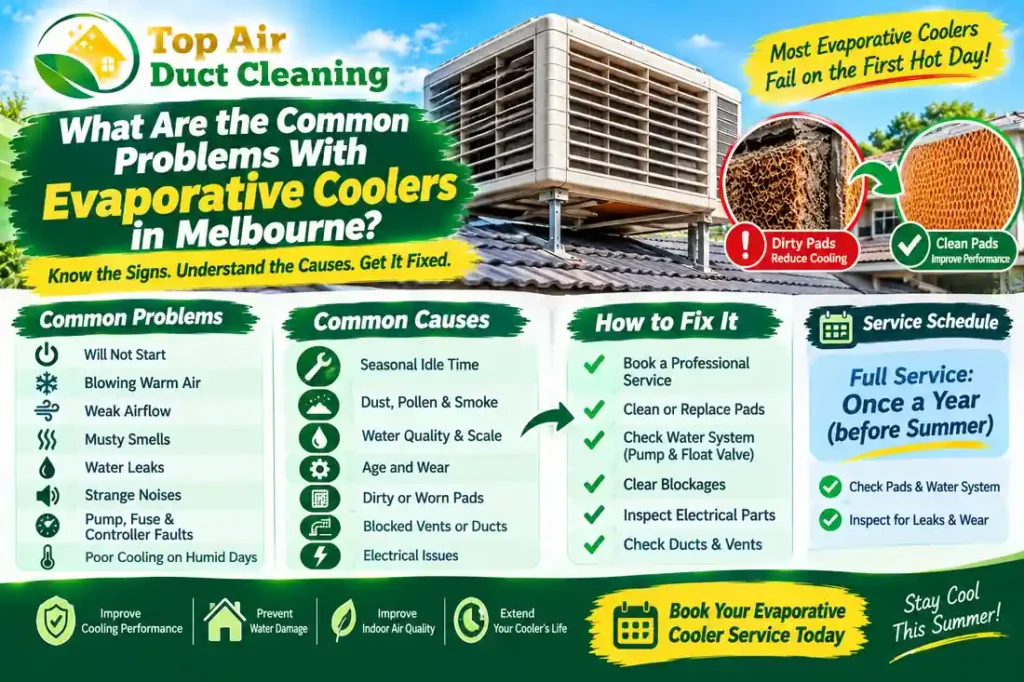
The most common evaporative cooler problems in Melbourne are failing to start after winter, blowing warm air, weak airflow, musty smells, water leaks, noises and electrical faults. Most come from months of idle time, worn or scaled pads, water system faults and years of roof exposure.
Most evaporative coolers fail on the first hot day, after months sitting idle.
Below, we explain each problem, what usually causes it, what you can safely check, and when to call a technician.
Evaporative Cooler Faults and Quick Fixes
Use this table to match what you notice with the most likely cause.
| Symptom | Likely cause | Safe check | Call a technician? |
|---|---|---|---|
| Will not start | Seized pump, capacitor, tripped breaker | Reset the breaker once | Yes |
| Warm air | Fan-only mode, dry or scaled pads, pump fault | Check the controller is on cooling | If it continues |
| Weak airflow | Clogged pads, worn belt, duct leaks | Check vents are open | Yes |
| Musty smell | Stagnant water, dirty pads | Run on fan, then book a clean | Yes |
| Water leak or overflow | Float valve, cracked sump, duct seal | Turn off the water | Yes |
| Noise | Belt, bearing, loose panel | Switch off if grinding | Yes |
| Weak cooling on humid days | High humidity, not a fault | Open windows wider | No |
Why Problems Show Up on the First Hot Day
Many Melbourne coolers sit unused for most of the year. The pump dries out, bearings stiffen and any water left behind turns stagnant.
Then the first heatwave arrives and the cooler is asked to work at full strength straight away.
Why Roof Exposure Matters
Most coolers live on the roof, in sun, rain, dust and the occasional bushfire smoke. Over the years, that wears seals, corrodes metal and clogs pads.
After 10 or 15 years, these small issues add up.
The 8 Most Common Evaporative Cooler Problems and How They Are Fixed
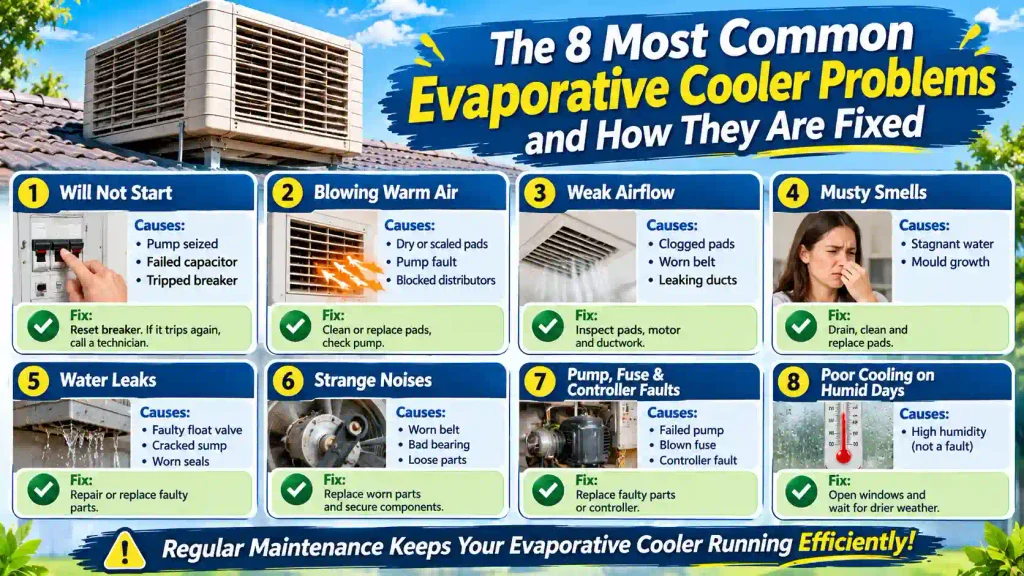
Here is each problem, what causes it, and how a technician usually fixes it.
1. The Cooler Will Not Start on the First Hot Day
This is the most common one. The usual causes are:
A seized water pump that sat dry over winterA failed capacitor, so the motor hums but does not turnA tripped breaker or blown fuse
Try resetting the breaker once. If it trips again, leave it and call a technician.
2. Blowing Warm Air or Not Cooling
First, check the controller is on cooling and not fan-only. Fan-only mode moves air without using the pump.
If it is on cooling, the cause is often dry or scaled pads, a pump that is not running, or blocked water distributors.
A technician cleans or replaces the pads, clears the water lines and checks the pump.
3. Weak or Poor Airflow
Weak airflow is usually one of three things.
Pads clogged with dust, salts or algaeA worn belt, failing motor or damaged fan bladesLeaking, disconnected or blocked ducts
A technician checks the pads and motor first, then the duct run if the roof unit looks fine.
4. Musty Smells and Mould Growth
Stagnant water and dirty pads can grow algae, mould and bacteria. The smell is usually strongest when the fan first starts.
A poorly kept cooler can spread musty air through the ducts, which may bother people with allergies or breathing sensitivities.
A technician drains and cleans the sump, and replaces pads that are too far gone.
5. Water Leaks and Overflow
A stuck float valve can overfill the tank, spilling water onto the roof or into the ceiling.
Older units, especially 15 years or more, can also have cracked or corroded sumps, or worn duct seals.
Any water in the ceiling is urgent. Turn the cooler and the water supply off, then call a technician.
We cover this problem in more detail in our guide to evaporative cooler overflow.
6. Strange Noises From the Roof
Different noises point to different faults.
Slapping or squealing: a worn or loose beltGrinding or rumbling: a failing motor bearingRattling: loose panels or debris in the fan housingSplashing: blocked water distributors
Switch the cooler off if you hear grinding, because a seized bearing can turn a small repair into a large one.
7. Pump, Fuse and Controller Faults
If the fan runs but there is no water, the pump or its capacitor may have failed.
If the wall controller is blank, the cause may be a blown fuse, a wiring problem or a failed controller.
These are electrical jobs, so they are best left to a licensed technician.
8. Poor Cooling on Humid Days
This one is not a fault. Evaporative coolers work by evaporating water, so they struggle when the air is already humid.
Once humidity climbs above roughly 55 to 60 per cent, cooling drops noticeably. Melbourne has humid, stormy days, especially after a cool change or rain.
Open windows a little wider to let moist air escape, and wait for conditions to dry out.
“If your cooler works on a dry 38 degree day but struggles on a humid 30, it is probably the weather, not the unit.”
Water Quality and Scale in Melbourne
Minerals and dust in the water leave deposits on pads and parts. How fast that happens depends on your water.
Is Melbourne Water Hard or Soft?
Melbourne’s mains water is generally soft, so scale usually builds slowly. Hardness can vary by area, though, and tank or bore water is often harder.
Dust, salts and age still clog pads over time, even where the water is soft.
Signs of Scale and Buildup
White or grey crust on the pads or in the sumpPads that are wet in some spots and dry in othersWater that trickles unevenly or not at allA float valve that sticks
If you see these signs, book a clean before summer.
What You Can Check Safely and What to Leave to a Technician
A few checks are safe from the ground. Most repairs need a trained person on the roof.
Safe Checks You Can Do
Make sure the controller is on cooling, not fan-onlyReset the breaker once, but not repeatedlyMake sure vents are open and windows are slightly openListen for running water from the roof unit when it is on
Jobs for a Technician
Motors, pumps, capacitors, float valves and any electrical fault should be handled by a licensed technician.
Roof access is also risky, so leave the unit itself to someone with the right equipment.
Expert tip: If your cooler hums but does not spin, switch it off at the wall. Running it can overheat the motor.
Repair or Replace Evaporative Cooler?
Most faults are worth repairing, especially pads, belts, pumps and float valves. These are routine parts and usually cost far less than a new unit.
Replacement starts to make sense when several problems show up together. Watch for a rusted or cracked cabinet, a sump that keeps leaking after repairs, a motor that has failed more than once, or a unit older than 15 years that needs a major part.
Older coolers also tend to use more water and power than newer models. If yours is near the end of its life and needs a big repair, ask your technician to compare the repair cost with a replacement before you decide.
How to Avoid Problems Before Summer
Most of these problems are easier to prevent than to fix in a heatwave.
Book a Spring Start-Up Service
| Part | What gets checked |
|---|---|
| Cooling pads | Scale, algae, dry spots, wear |
| Water pump | Runs freely, no leaks |
| Float valve | Shuts off at the right level |
| Sump | Cracks, corrosion, sludge |
| Motor and belt | Tension, bearing noise, wear |
| Water distributors | Even flow across all pads |
| Ducts and outlets | Seals, leaks, blockages |
Have the cooler checked in spring, before the first hot days. The pads, pump, water lines and motor can all be tested while there is no rush.
Our guide to how often an evaporative cooler needs servicing explains the schedule in detail.
Winter Shutdown
At the end of the season, drain the water so it does not sit stagnant through winter. That one step cuts the risk of smells, mould and a seized pump when summer returns.
Expert tip: Book early. Spring is busy, and slots disappear once the first heatwave arrives.
Frequently Asked Questions Evaporative Cooler Servicing
1. Is it normal for the cooler to smell when it first starts?
A brief stale smell can happen after months idle. A strong smell that lasts means dirty pads or stagnant water, so get it checked.
2. Can I keep using the cooler if the ceiling is dripping?
No. Turn it off and shut off the water, because ongoing leaks can damage the ceiling and cause mould.
3. Do I need windows open when it is running?
Yes. A cooler pushes fresh air into the house, so air needs somewhere to escape. Open a window slightly in the rooms you are using.
4. How long do evaporative coolers last?
With regular servicing, many last 10 to 15 years or more. Poor maintenance, scale and roof exposure can shorten that.
5. Can replacing the pads fix warm air?
Sometimes. Worn pads are a common cause, but the pump, water supply and distributors can also be at fault, so get it diagnosed first.
Conclusion
The common problems with evaporative coolers in Melbourne are usually predictable: months of idle time, tired pads, water system faults and roof wear. Catch them in spring and most are quick to sort.
Top Air Duct Cleaning services homes and commercial sites across Melbourne, seven days a week. Contact us today and get a clear quote before any work begins.
