
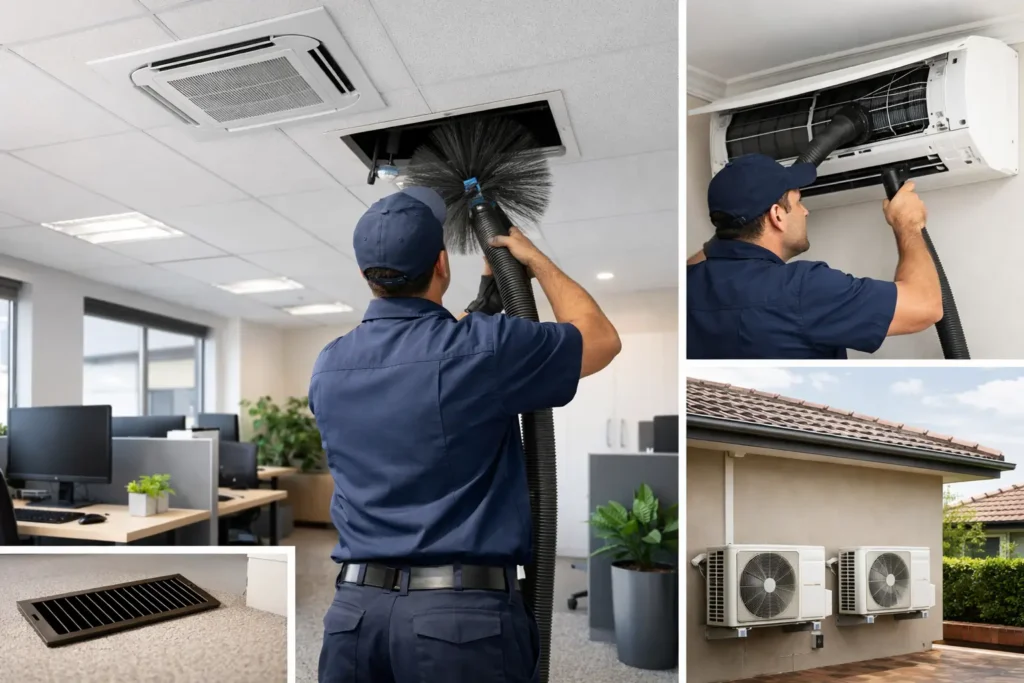
A persistent layer of dust on desks was the first visible problem. The larger issue was hidden above the ceiling tiles: an office HVAC system carrying years of fine debris through occupied work areas. This office duct cleaning case study follows a typical Melbourne workplace scenario and shows what a professional clean can realistically achieve, where the limits are, and why the result depends on more than simply vacuuming a vent.
The Office Duct Cleaning Case Study: The Starting Point
The site was a medium-sized office occupying one level of a multi-tenant commercial building. It accommodated around 35 staff, with a mix of open-plan desks, meeting rooms, private offices and a reception area. The ducted heating and cooling system ran most weekdays and was used heavily through Melbourne’s hot summers and cool mornings.
The facilities contact initially called because staff were commenting on stale air after the system started each morning. Cleaners were also finding unusual dust accumulation around supply grilles, particularly in meeting rooms where doors stayed closed for long periods. The office had recently been refurbished, which raised another concern: plaster dust and fine construction debris may have entered the return-air pathway.
No single symptom proves that ducts need cleaning. Dust on furniture can come from open windows, foot traffic, carpets or nearby works. Stale air can also relate to outside-air settings, blocked filters, an undersized system or a maintenance issue with the air-conditioning unit itself. A proper assessment is what separates useful duct cleaning from a service that treats every problem as a dirty duct.
At this site, inspection of accessible grilles, return-air sections and duct openings found visible dust deposits, loose debris near several return points and evidence of renovation-related particulate build-up. The air filters were also overdue for replacement. The findings supported a full duct cleaning service alongside filter maintenance, rather than a quick grille clean.
What the Inspection Revealed
Before equipment was brought inside, the technician discussed the office layout, operating hours and areas that needed extra care. This included protecting workstations, managing access around staff and scheduling noisier parts of the work outside the busiest periods where possible.
The inspection focused on the parts of the system that affect indoor air quality and airflow most directly: supply ducts, return ducts, grilles, diffusers, accessible branch lines and the return-air plenum. The team also checked for signs that would require a different contractor or further investigation, such as damaged duct insulation, moisture intrusion, active mould growth or mechanical faults.
That distinction matters. Duct cleaning removes accumulated dust and debris. It does not repair a failed fan motor, redesign poor ventilation or solve condensation caused by an underlying building issue. If moisture or mould is present, the source of the moisture must be addressed or contamination can return.
In this case, there was no active water damage or visible mould growth in the accessible ductwork. The system was suitable for cleaning, and the client received a clear scope of work before the job began. Transparent quoting gave the facilities contact confidence about what was included and avoided surprises once work was underway.
The Cleaning Process Without Disrupting the Office
The job was scheduled in stages to keep the workplace functional. Staff did not need to vacate the entire floor, but the team coordinated access to meeting rooms and desk zones as each section was cleaned.
Professional HEPA filtration equipment was used to capture loosened debris during the process. This is particularly important in commercial spaces because disturbing dust without proper containment can shift it from the ductwork back into the office. The aim is not to create a dramatic cloud of dust. It is to remove contamination in a controlled manner.
Technicians cleaned accessible supply and return duct runs using specialised agitation tools and high-powered extraction. Individual grilles and diffusers were removed where appropriate, cleaned, and refitted. Return-air areas received particular attention because they collect airborne lint, paper fibres, carpet dust and renovation debris over time.
The team also replaced the overdue filters and checked that grilles were correctly refitted. This final detail is easily overlooked. A loose, damaged or poorly seated grille can affect appearance, create rattling and allow dust to collect unevenly around the opening.
The work took most of a day, with timing dependent on the size of the duct network, access above ceilings and the amount of build-up found. A smaller office may be completed more quickly, while a multi-storey site, medical practice, school or building with several air-handling units needs a more detailed program.
Why Surface Cleaning Was Not Enough
The office cleaner had already been wiping grilles regularly, which helped the visible presentation of the rooms. However, wiping the face of a grille does not remove debris sitting further inside the duct or at the return-air intake. It also does not address an overdue filter.
Surface cleaning still has a role. It should be part of normal workplace cleaning. Professional duct cleaning becomes worthwhile when there is visible internal build-up, post-renovation contamination, recurring dust around vents, poor airflow concerns or a long gap in HVAC maintenance.
Results the Facilities Team Could See and Feel
Immediately after the work, the most obvious change was the condition of the grilles and return-air points. They were clean, free of visible dust deposits and properly refitted. The facilities contact also noted that the morning start-up smell was no longer noticeable in the enclosed meeting rooms.
Over the following weeks, the cleaning contractor reported less dust collecting around vents during routine cleaning. Staff feedback was broadly positive, especially from people working near the return-air sections. The office felt fresher, although it is sensible not to promise that duct cleaning alone will eliminate every allergy or comfort complaint.
The practical result was a cleaner air-distribution pathway and a better-maintained HVAC system. Removing built-up debris can support airflow and reduce the amount of dust recirculating through an office. Replacing clogged filters also helps the system operate as intended. The actual energy benefit varies depending on filter condition, duct design, the age of the unit and whether there are existing mechanical faults.
For this client, the strongest value was not a single dramatic metric. It was improved housekeeping, fewer visible dust concerns, better confidence in the workplace environment and a sensible maintenance baseline after refurbishment.
What This Office Changed in Its Maintenance Plan
After the cleaning, the office introduced a more structured approach. Filters were placed on a documented inspection and replacement schedule, rather than being changed only when someone noticed a problem. The facilities contact also arranged for vents and return grilles to be visually checked during regular cleaning rounds.
The next professional duct inspection was planned around future renovation activity, changes in occupancy and HVAC performance rather than an arbitrary date. Many offices benefit from periodic cleaning, but frequency depends on usage. A busy office near construction works, a school with high daily occupancy or a site with heavy foot traffic may need attention sooner than a lightly used professional suite.
Property managers should also consider the building arrangement. In a shared commercial building, the tenancy may be responsible for internal ductwork and filters while the landlord manages central plant or common systems. Clarifying that responsibility early prevents missed maintenance and avoids assuming another party has handled it.
When to Arrange Office Duct Cleaning
An office should arrange an assessment when dust is repeatedly appearing around vents, airflow has noticeably dropped, refurbishment has created fine debris, filters are consistently dirty, or occupants raise persistent concerns about stale indoor air. A strange smell, water marks near ceiling vents or visible mould should be treated as a priority, because these signs may point to an issue beyond ordinary dust build-up.
A reliable contractor will inspect first, explain the scope in plain language and tell you if duct cleaning is not the only answer. That practical honesty protects your budget and helps ensure the work addresses the real cause.
For professional office duct cleaning, ducted heating and cooling cleaning, filter-related advice and indoor air quality support across Melbourne, contact Top Air Duct Cleaning for a free quote on 0457 666 469 or visit www.topairductcleaning.com.au. A clean, well-maintained ventilation system gives your team one less workplace concern to carry into the day.
