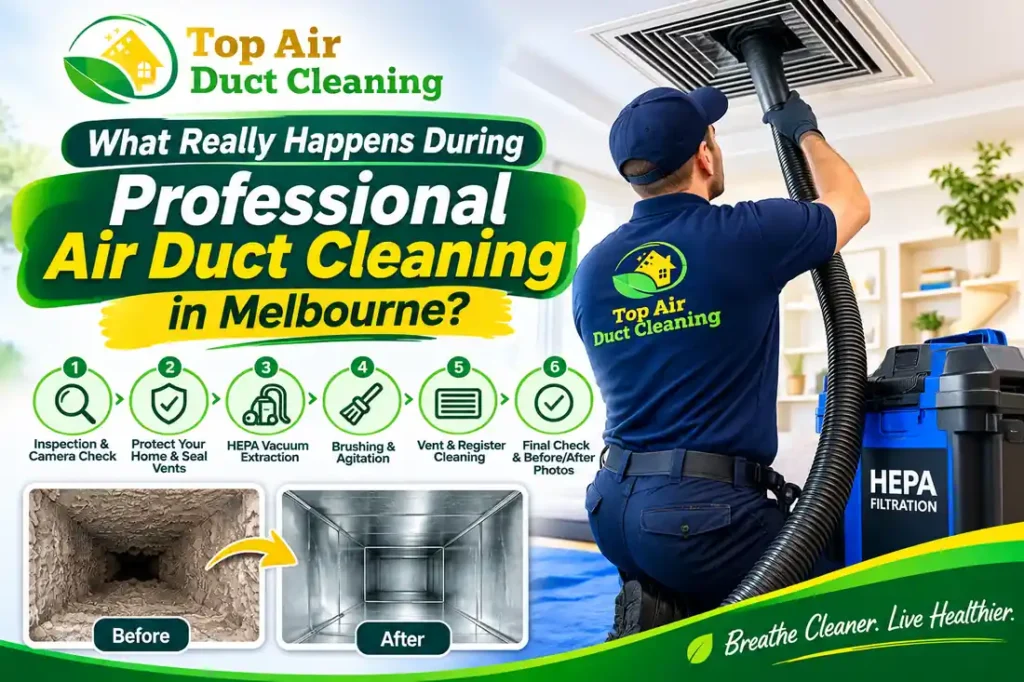
The professional air duct cleaning process has six steps: inspection, protecting your home, sealing vents, extraction with a HEPA vacuum, brushing, and a final check. A good team cleans the inside of your ducts, not just the vents you can see.
Most Melbourne homes take about 2 to 4 hours. If a cleaner only wipes your vents and leaves, that is not a proper duct clean.
Below is exactly what happens, how to prepare, and how to spot a job done right.
The Professional Air Duct Cleaning Process, Step by Step
Every proper clean follows the same order. Here is what a trained team does in your home, from the first look to the final check.
Step 1: Inspection and Duct Inspection Camera Check
The technician starts by looking at your whole system, including the heater or cooler, the return air duct and the vents. A small duct inspection camera shows what is going on inside the ducts.
This reveals how dirty things really are. It also shows damage, loose joins or mould before any cleaning begins.
Step 2: Protecting Your Home and Sealing Vents
The team lays drop sheets near the vents and switches the system off for safety. They then seal the vents they are not working on.
This stops dust escaping into your rooms and pushes it towards the extraction point. It is a small step, but it keeps your home clean during the job.
Step 3: Negative Air Pressure and HEPA Vacuum Extraction
This is the heart of the job. A powerful HEPA vacuum is connected to the duct system and creates negative air pressure. That pulls air and dust one way, out of your home and into the machine.
HEPA filters trap fine particles like pollen and dust mites, so they are not blown back inside.
“Suction alone moves loose dust. Suction plus agitation clears what is stuck.”
Step 4: Agitation and Rotary Brush Cleaning
Dust clings to duct walls, so suction is not enough on its own. Technicians use rotary brushes and air tools to loosen the buildup from inside the ducts.
The loosened dust is pulled straight into the vacuum. The team works through each run, including the main trunk lines and return air duct cleaning.
Brush type matters, because flexible and metal ducts need different tools to avoid damage.
Step 5: Vent and Register Cleaning
Vent covers and registers come off and are cleaned by hand. The team also cleans the fan area and the accessible parts of the heating or cooling unit, because dust builds up there too.
The covers then go back on, and the system is reconnected.
Step 6: Final Inspection and Before and After Check
The camera goes back in to confirm the ducts are clear. The technician then tests airflow at the vents and shows you before and after photos.
On gas ducted heating, a carbon monoxide test is a smart extra check.
Expert tip: Ask for before and after photos every time. If a cleaner cannot show you the inside of your ducts, you cannot tell what was actually done.
How Long Does It Take to Clean an Air Duct?
Most standard Melbourne homes take around 2 to 4 hours. Larger homes and very dirty systems take longer.
What Affects the Time
Size matters most, but it is not the only factor.
- Number of vents and duct runs
- Whether you have ducted heating, evaporative cooling or both
- How easy the roof space or under-floor ducts are to reach
- How heavy the dust or mould buildup is
Why Rushing Is a Red Flag
A full-house clean done in well under an hour usually means only the vents were wiped. Proper agitation and extraction take time, so a thorough team will not hurry the brushing step.
How Do I Prepare for Duct Cleaning?
Good news: there is not much to do. A little prep helps the team work faster.
Before the Team Arrives
- Move furniture, rugs and toys away from vents
- Make sure the team can reach the unit, roof space or under-floor ducts
- Tell them about smells, noises or rooms with weak airflow
- Plan where pets will stay during the visit
On the Day
Have someone home so the team can get access and talk you through the results. Expect some noise from the vacuum, which is normal.
Keep kids and pets away from work areas. Do a quick walk-through at the end before the team packs up.
Expert tip: Snap a photo of your dustiest vent before the clean. It makes the difference easy to see afterwards.
What Is the Australian Standard for Ductwork?
As far as we know, there is no single national rulebook that sets out how residential ducts must be cleaned. But several Australian standards cover how ductwork is built, ventilated and kept safe.
The Main Standards to Know
These are the ones you will hear about most.
- AS 4254: ductwork for air-handling systems in buildings
- AS 1668: mechanical ventilation and air conditioning in buildings
- AS/NZS 3666: microbial control of air-handling systems, mainly for commercial buildings
What This Means for Your Home
These standards mostly guide design and installation, so they do not give you a cleaning checklist. Instead, look for a trained team with proper insurance, police checks and clear photo reports.
Any gas appliance repair should be done by a licensed gas fitter. If you manage a commercial site, check the current standards that apply to your building before you book.
Signs Your Ducts Need Cleaning
Your home usually tells you when ducts need attention. Watch for these three groups of signs.
Visible Signs
Dust around the vents is the easiest clue. Black specks or fuzzy spots on the registers can point to mould.
If dust blows out when the heater starts up, there is likely buildup inside.
Smell and Health Signs
A musty or stale smell when the system runs is a common warning. More sneezing, coughing or itchy eyes at home can also be linked to dusty ducts, especially with pets.
Performance Signs
Weak airflow, rooms that never get warm or cool, and a system that runs longer than usual are all worth checking.
How Often Should Ducts Be Cleaned?
As a general guide, many Melbourne households clean every 2 to 3 years. Clean sooner if you have pets, allergies, smokers or recent renovations. Renovation dust travels deep into ducts.
DIY vs Professional Duct Cleaning
Wiping your vents is fine between cleans, but it does not reach the ducts themselves.
| Factor | DIY | Professional |
|---|---|---|
| Reach | Vent covers only | Full duct runs and the unit |
| Equipment | Household vacuum | HEPA vacuum and rotary brushes |
| Dust control | Dust can spread | Negative air pressure contains it |
| Mould check | Hard to spot | Camera inspection |
| Proof of work | None | Before and after photos |
Is Professional Duct Cleaning Worth It?
For most homes, yes, especially if you use ducted heating all winter.
Dust, Mould and Allergen Removal
Dust, pollen, pet hair and mould spores collect inside ducts over time. Every time the system runs, some of it moves into your rooms.
Dust, mould and allergen removal at the source gives you a cleaner home.
Better Airflow and System Efficiency
Blocked ducts make your system work harder to push air through. Cleaning restores airflow, which helps rooms heat and cool evenly and supports system efficiency.
What Makes Duct Cleaning in Melbourne Different
Melbourne has cold winters and hot, dry summers, so many homes use both gas ducted heating and evaporative cooling.
Ducted Heating and Evaporative Cooling
These two systems collect different problems. Ducted heating cleaning deals mainly with dust and debris, while evaporative cooling duct cleaning also needs to address moisture and mineral buildup.
A good team cleans each system to suit its type, rather than using one method for everything.
The Best Time of Year
Book ducted heating cleaning in autumn, before you turn the heater on for winter. Book evaporative cooling duct cleaning in spring, before the first hot days.
Expert tip: Book early. Autumn and spring are the busiest times for Melbourne duct cleaners.
Frequently Asked Questions Air Duct Cleaning Service
1. Do I need to be home during duct cleaning?
It helps. Someone should be there to give access and see the results at the end.
2. Will duct cleaning make a mess?
Not with the right setup. Drop sheets, sealed vents and negative air pressure keep dust contained.
3. Can duct cleaning remove mould?
It can remove surface mould and the dust it feeds on. Heavy mould may also point to a moisture problem that needs fixing.
4. How do I know the job was done properly?
Ask for before and after photos, and check that the vents and registers are clean.
5. Will it get rid of bad smells?
Often, yes. Smells from dust and mould inside ducts usually fade once they are cleaned out.
Conclsuion
The professional air duct cleaning process is simple when it is done properly: inspect, seal, extract, brush, clean and check.
If you want a team that shows you the results, Top Air Duct Cleaning services homes and commercial sites across Melbourne, seven days a week.
Book your clean today, and get a clear quote before any work begins.
